|
|
|
|
|
|
|
|
|
|
Conus sieboldii (Reeve, 1848)
Description: Moderately large to large, moderately solid to solid. Last whorl usually conical or ventricosely conical; outline variably convex at adapical third to half, straight below; left side often slightly concave toward base. Shoulder broadly carinate. Spire of moderate height and stepped, outline straight to slightly concave. Larval shell of 3 whorls, maximum diameter 1.1 mm. Postnuclear spire whorls carinate, first 4-7 also tuberculate. Teleoconch sutural ramps concave, with densely spaced radial threads, sometimes with numerous spiral striae in late whorls. Last whorl with punctate or axially striate spiral grooves from base to centre, separating narrow ribbons or ribs anteriorly and broad ribbons posteriorly.
Casing top-shaped, with short-conical, pointed, step-shaped spiral. The whorls are shallowly rimmed, eight in number, without sculpture, only bearing slightly curved growth lines. The spiral angle is sharp, the terminal whorl constricted at the front and here with small spiral grooves, but otherwise completely smooth (2).
Among recent specimens of C. sieboldii Reeve of Japan, which varies greatly in the shape of its shell, there was also an individual distinguished from the others by its more compact form, which agrees in all points with the fossil described here (2).
The latter is very close to Conus scalaris Mart. from the Miocene of the Tji Karang Valley in Java, but C. scalaris has a more raised, concave-looking, and striated spiracle; its shell is also not constricted anteriorly (2).
Conus marginatus Sow. of Cutch (Trans. Geolog. Soc. of London, ser. 2, vol. 5, tab. 26, fig. 35) is also closely related, but likewise differs by a higher spiracle and by the more pronounced spiral striations of the frons (2).
One specimen. Locality: Ngembak (2)
A single specimen, a little over 50 millim. in height and 23 millim. in diameter. Although the surface is much worn and the apical part of the spire is broken, the slender and longly conical shell with carinated shoulders and sunken whorls are too characteristic to be mistaken for any other species than that above mentioned. The transverse grooves at the lower part of the bodywhorl number about six.
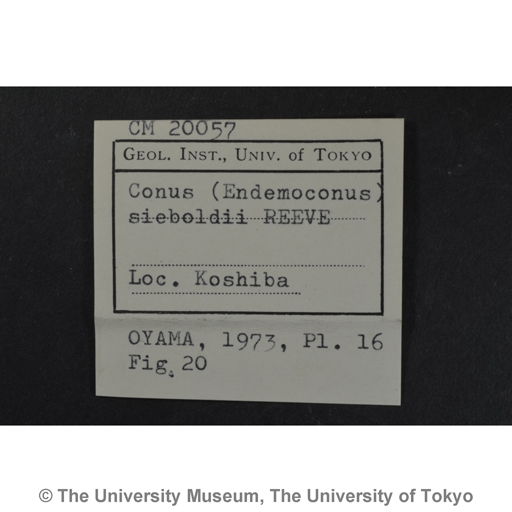
Fossil occurrence.-Koshiba Zone (Koshiba). Living.-Central Japan; China (3).
|
|
|
|
|
|
|
|
|
|
Bibliografia